
Faction · Tier A · +5% INT
Arcane Council — the faction whose duels behave differently
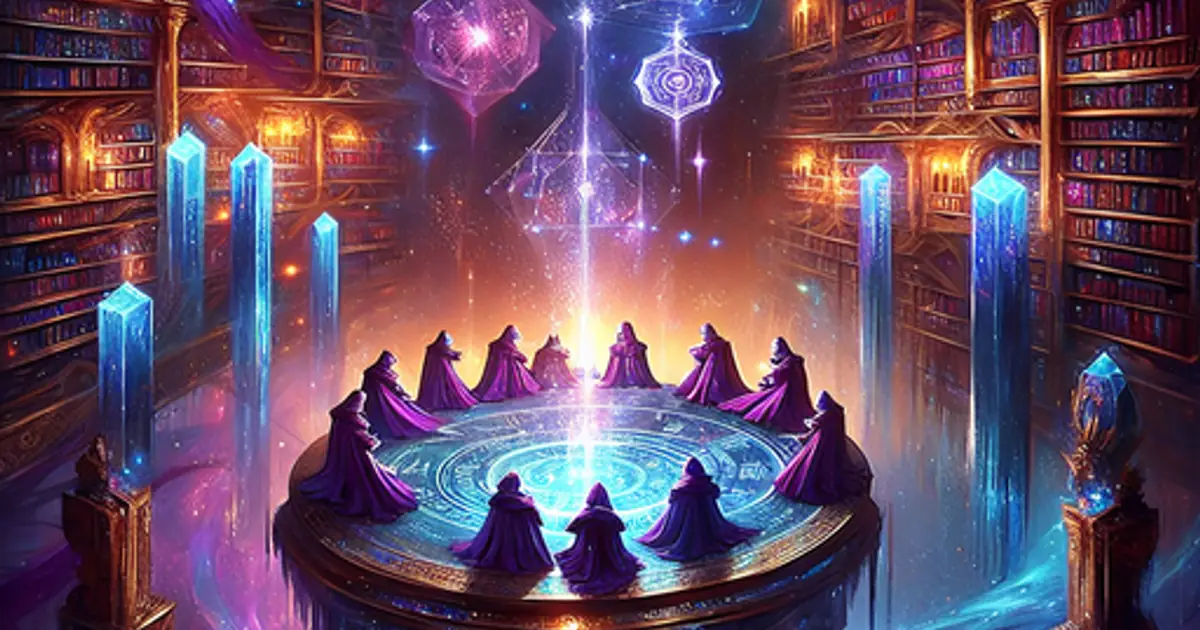
Scholars of the forbidden, masters of the arcane. +5% INT passive, six Arcane Library rooms, the seven-tier Insight Rank ladder — and arcane duels that anchor to your top member instead of using the 0.25× multiplier every other 1v1 faction system applies.
Updated ·patch v2.0.5
TL;DR
The Arcane Council faction in one paragraph — +5% INT to every member (build-conditional, hence Tier A not S). Exclusive Arcane Library building. Insight Rank ladder mirroring the other rank-room factions' shape (seven tiers, same threshold pattern). The Arcane Library has six rooms including the Leyline Nexus (ATK+SPD dual-stat, faction-signature room). What makes Arcane Council mechanically distinct is the duel calibration: while Wild Clan, Honorbound, and Hermit Realm 1v1s all use SPIRIT_TRIAL_1V1_MULT = 0.25× to make single-champion fights beatable, Arcane Council duels anchor to your strongest member's power instead. The implication shapes who should commit here.
The faction at a glance
Passive bonus
+5% Intelligence on every member of the faction. Same magnitude as Honorbound's ATK and Wild Clan's SPD — but INT is a narrower stat. It boosts ability damage on Casters and any essence that scales on intelligence (Joy, Faith, Forgiveness, Staff, Water). On non-INT builds, it sits dormant.
Exclusive Arcane Library
The Arcane-Council-exclusive structure. Unlocks the six-room arcane-progression system, the arcane_research quest type, and access to the Veil-Tome spec questline. Like every faction's exclusive, locks loyalty — other factions can't construct this building in the region.
Arcane Council is Tier A in the faction tier list — "build-defining when matched correctly; dead weight when mismatched." If your roster is all-Caster, the math moves Arcane Council to your personal S-tier. If it's mixed archetype, it stays in A.
The duel-anchor distinction — the mechanically unique thing
Every other faction's 1v1 system (Wild Clan Spirit Trials, Honorbound Honor Duels, Hermit Realm equivalents) calibrates challenger power by multiplying the party-of-4 stage curve by SPIRIT_TRIAL_1V1_MULT = 0.25. Without that adjustment, a single champion against a party-of-4-tuned challenger would lose by default.
Arcane Council duels do not apply that multiplier. Per arcane_council_system.gd:_get_duel_base_power, the challenger pool anchors to your strongest member's total power — it iterates all members, picks the highest get_total_power(), and scales challengers against that floor (with a 150 fallback if no members exist).
Practical implication:
- ·A single top-tier champion thrives. The challenger floor is your strongest member's power. That member fights at-level; your weaker members fight above-level. If you have one outlier, send them.
- ·Roster balance is punished. If your power distribution is flat across the roster, every member fights at-floor — no one has the headroom that Spirit Trials' 0.25× multiplier provides.
- ·Investment compounds. Rank up one Caster aggressively rather than spreading investment across the roster, and Arcane Council duels get easier. The math rewards specialization.
The six Arcane Library rooms
Six rooms, all capping at level 5. Same upgrade structure as every other rank-room faction (gold + Insight Points, Scholar-rank gate for level 3+). The Leyline Nexus is the faction-signature dual-stat room — same shape as Wild Clan's Totem Pole, Hermit Realm's Wardstone Circle, and Diplomatic Court's Negotiation Chamber, but tuned for offense (ATK+SPD).
| Room | Effect | L1 | L2 | L3 | L4 | L5 |
|---|---|---|---|---|---|---|
Leyline Nexus | +ATK and +SPD (faction-signature dual-stat room) | +2/+2% | +4/+4% | +6/+6% | +9/+9% | +13/+13% |
Grimoire Vault | Grimoire storage capacity | 10 | 20 | 35 | 55 | 80 |
Astral Observatory | +essence drop chance from clears | +5% | +10% | +18% | +25% | +35% |
Mending Chamber | Reduces injury recovery time | +10% | +18% | +25% | +35% | +50% |
Ether Well | +idle gain rate | +5% | +10% | +15% | +22% | +30% |
Arcane Atheneum | +bond XP gain between members | +8% | +15% | +25% | +35% | +50% |
Leyline Nexus + Astral Observatory together stack +13% ATK, +13% SPD, and +35% essence drop chance at level 5 — that's an offensive-leaning room loadout that pairs cleanly with the INT-scaling passive on caster builds. Arcane Atheneum's bond XP bonus is the late-game compounding pick for accelerating your top member's progression (which, per the duel-anchor mechanic, is the right play).
Insight Rank — the seven-tier ladder
Same shape as the other rank-room factions. Earn Insight Points from arcane duels, the arcane_research quest type, and other Arcane-Council-flavored activities. Climb the ladder, unlock room-upgrade levels gated by Scholar rank.
| Rank | Name | Insight points | Notes |
|---|---|---|---|
| 0 | Apprentice | 0 | starting rank |
| 1 | Adept | 50 | — |
| 2 | Scholar | 150 | unlocks Arcane Library room levels 3+ |
| 3 | Magister | 350 | — |
| 4 | Archon | 700 | — |
| 5 | Sage | 1,200 | — |
| 6 | Archmage | 2,000 | max rank |
The Archmage rank caps at 2,000 Insight Points — same as the equivalent caps in Wild Clan (Primal Lord), Honorbound (Champion), and Hermit Realm (Eternal Hermit). All four ladders share the threshold shape; only the rank names and flavor differ.
The three Arcane Duel approaches
Each duel offers a choice of approach, applied as a stat-multiplier profile to your selected member:
Evocation
Offensive — leans into ATK multipliers. Best for casters whose strongest stat is attack and whose ability damage scales directly off it.
Abjuration
Defensive — DEF and VIT multipliers. The choice when your top member is a durable caster (Water essence, Cinder, etc.) and the challenger threatens to out-damage you in trade.
Transmutation
Balanced — SPD and INT multipliers. The utility option that scales both turn-order and ability magnitude. Default if you're unsure which approach the challenger's stat profile rewards.
The system picks the best applicable multiplier from your chosen approach against the challenger's stat profile. If your member's strongest stat matches the challenger's weakness AND your approach leans into that stat, the multiplier stack can decisively shift outcomes. Otherwise it's a wash — challenger power is your top member's anchor, so the duel is tight by default.
The Veil-Tome — the spec quest line
Arcane Council loyalty opens the faction's spec quest storyline, The Veil-Tome. The setup, from the source:
An unmarked codex bound in salt-tanned hide surfaces in a swamp peat-cutter's market. Five sentences in, your archmage stops reading and demands a containment circle. The book is awake. The book is talking. The book wants to be read.
Three named characters anchor the story. Archmage Tevren of the Black Library is your senior council member — "late sixties, reads first, always. Already regrets reading first." Apprentice Lirha is your most promising apprentice, early twenties, "earnest, fast, terrified of her own competence, speaks in long single breaths." Magistra Vella Crail is a rival academic from the Obsidian Circle, mid-fifties — "treats every conversation as a publishable transcript" and has already read further into the tome's lineage than your own archmage.
The Veil-Tome is the most knowledge-as-danger arc in the game. The book itself is the antagonist — and partly the subject of seduction. Tevren's "reads first, always" framing is the spec quest's signature line; the whole arc plays out as a slow-acceleration scholarly horror that the knowledge-hoarding faction is uniquely positioned to host.
When to commit Arcane Council
- ·Your roster centers on Casters. +5% INT compounds across every caster's ability damage. Combined with the Leyline Nexus's +13% ATK at level 5, an all-Caster region under Arcane Council loyalty is one of the strongest offensive configurations in the game.
- ·You have one top-tier champion you're investing in. The duel-anchor mechanic rewards specialization. If your power distribution is steeply skewed toward one member, Arcane duels become favorable in a way Spirit Trials never do.
- ·You enjoy scholarly-horror narrative. The Veil-Tome arc is unlike any other faction questline — the antagonist is a book that wants to be read. If moral-weight branching (Honorbound's Crimson Oath) or tactical-defense scenarios (Hermit Realm's Stone Pact) aren't your thing, this might be.
- ·You're building a Soul-Tree branch that scales on INT. Account-wide INT scaling from soul tree passives compounds with Arcane Council's +5%. The long-game synergy is real.
Common mistakes
- Treating Arcane duels like Spirit Trials. They're not the same. Spirit Trials' 0.25× multiplier makes solo fights forgiving; Arcane duels anchor to your strongest member with no such cushion. Sending a mid-tier member to an Arcane duel doesn't give them headroom — it gives them an at-level fight against your top member's calibrated challenger.
- Spreading investment across the roster equally while running Arcane Council. The duel-anchor math rewards concentration. Pick a top champion and invest in them; the duels get easier as their lead over the field widens. Counter-intuitive against the broader game's roster-balance advice.
- Picking Evocation against every challenger. Evocation's ATK lean wastes if the challenger's weakness is DEF or SPD. Read the challenger's stat profile before picking the approach.
- Committing Arcane Council with an INT-light roster. The +5% INT passive does nothing for Strikers, Rangers, or Guardians. If your roster doesn't lean INT, the faction tier list puts Honorbound's +5% ATK in front every time.
FAQ
Why are Arcane Council duels different from Spirit Trials and Honor Duels?
Three of the four 1v1 faction systems (Wild Clan Spirit Trials, Honorbound Honor Duels, Hermit Realm equivalents) apply a 0.25× multiplier (SPIRIT_TRIAL_1V1_MULT) to the party-of-4 stage curve so a single champion can clear. Arcane Council duels do NOT. They anchor to the player's strongest member's power instead — the challenger pool scales from your top roster slot. The implication: Arcane duels reward roster depth differently. A widely-distributed roster underperforms an Arcane Council commitment; a single top-tier champion thrives.
What are the three Arcane Duel approaches?
Evocation, Abjuration, and Transmutation. Each is a stat-multiplier profile applied to your selected member. Evocation leans ATK, Abjuration leans defensive (DEF/VIT), Transmutation is the balanced/utility option (SPD/INT). The system picks the best applicable multiplier from your chosen approach against the challenger's stat profile — similar shape to Wild Clan's Feral/Cunning/Endurance and Honorbound's choice mechanics, different stat themes.
What does the Insight Rank ladder unlock?
Same shape as Wild Clan's Primal Rank and the others: seven tiers, identical threshold pattern (0/50/150/350/700/1200/2000 Insight Points). Apprentice → Adept → Scholar → Magister → Archon → Sage → Archmage. Scholar (rank 2 at 150 points) is the meaningful gate — it unlocks Arcane Library room levels 3 and above, mirroring the Sentinel / Veteran / Beastcaller gate pattern used by every other rank-room faction system.
Is the Leyline Nexus a unique dual-stat room?
No — it's the ATK+SPD entry in the faction-signature dual-stat room family. Each rank-room faction has a dual-stat signature: Leyline Nexus (ATK+SPD), Wild Clan's Totem Pole (ATK+VIT), Hermit Realm's Wardstone Circle (DEF+VIT), Diplomatic Court's Negotiation Chamber (SPD+DEF). All four cap at +13%/+13% at level 5. The dual-stat shape is shared; the stat pairs are what distinguish each faction's defensive or offensive lean.
Why is Arcane Council Tier A and not Tier S?
Because +5% INT is a build-conditional passive — meaningful only to roster slots that scale on INT. Casters benefit; Strikers don't. The faction tier list ranks by how many builds get value from a passive; INT is narrower than ATK or gold-multiplier, which is why Honorbound, Trade Cohort, and Hermit Realm sit in S. Arcane Council reaches S-tier strength only when the entire roster leans into INT scaling. With a mixed roster it's solidly Tier A.
Related: faction tier list · Hermit Realm guide · soul tree