
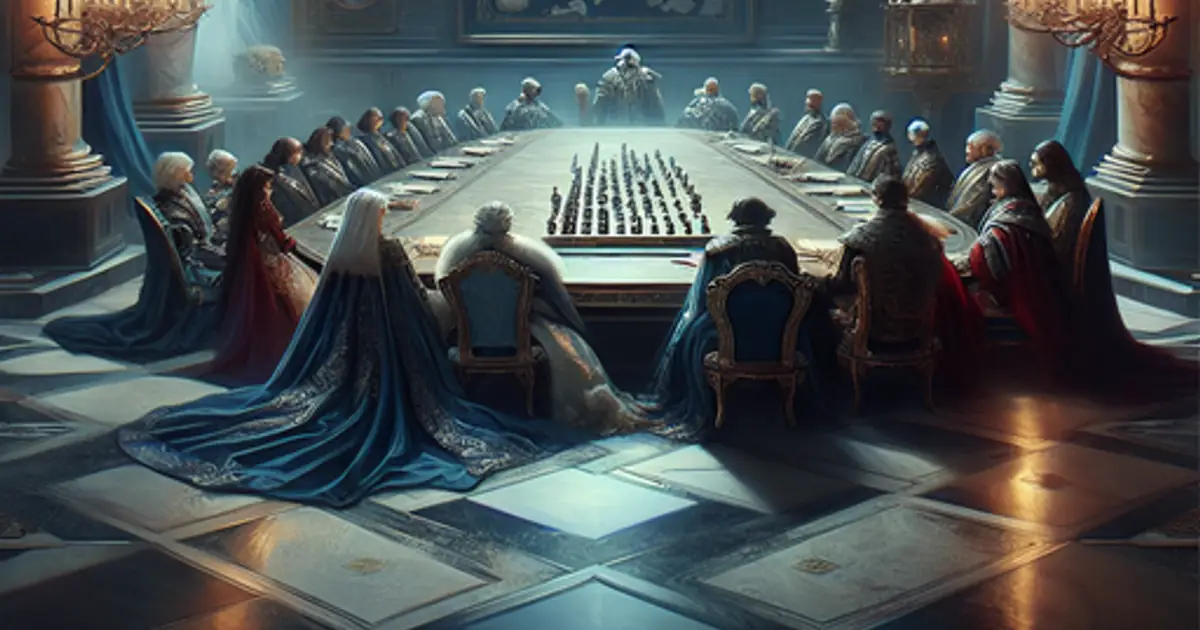
Faction · Tier C · +10% influence
Diplomatic Court — the influence faction
Words are weapons, alliances are armor. The +10% influence passive sits dormant if you don't engage the diplomacy system — and quietly outperforms most stat passives if you do. The Embassy's Negotiation Chamber is the SPD+DEF entry in the dual-stat signature room family.
Updated ·patch v2.0.5
TL;DR
The Diplomatic Court faction in one paragraph — +10% influence on every member of the faction (specialized resource, not gold or a stat). Exclusive Embassy building with six rooms including the Negotiation Chamber (clean dual-stat SPD+DEF signature room, both up to +13% at level 5). Seven-tier Renown Rank ladder Attache to Grand Diplomat. Diplomatic Court 1v1s share the standard SPIRIT_TRIAL_1V1_MULT calibration. Twin Crowns spec quest plays out as a multi-act mediation between two sympathetic rivals. Tier C because the passive's value gates behind diplomacy engagement — high ceiling, zero floor.
The faction at a glance
Passive bonus
+10% influence on every member of the faction. Influence is the diplomacy system's specialized currency — earned from diplomatic missions and the Faction Hall global pledge, spent on negotiation outcomes and treaty consolidation. The passive's value is proportional to how much diplomatic content you actually run. Zero engagement, zero value.
Exclusive Embassy
The Diplomatic-Court-exclusive structure. Unlocks the six-room progression system, the diplomatic_mission quest type, and the Twin Crowns spec questline. The Embassy's Negotiation Chamber dual-stat signature room is the tangible offensive-defensive value layered on top of the specialized passive.
Diplomatic Court is Tier C in the faction tier list — gated specialist. Tier C explicitly means "specialized, not weak." If you're committing to the diplomacy lane, Diplomatic Court is your S tier. If you're not, the passive sits dormant and the room bonuses + spec quest become your only value.
Influence vs the other faction resources
Most factions feed a per-faction rank currency (Honor / Primal / Insight / Solitude / Devotion / Dominion / Tracking / Renown / Infamy). Diplomatic Court is one of two factions whose passive boosts something other than the universal economy:
| Resource | Faction passive | Triggered by |
|---|---|---|
| Gold | Trade Cohort +10% | Every gold source — universal |
| Influence | Diplomatic Court +10% | Diplomatic missions + Faction Hall pledge — gated |
| Espionage | Thief Syndicate +10% | Heist quests + intel networks — gated |
Influence and espionage share the "gated resource" shape that puts Diplomatic Court and Thief Syndicate in Tier C. Gold is universal, so Trade Cohort sits in Tier S. Same +10% number, fundamentally different value distribution.
The six Embassy rooms
Six rooms, all capping at level 5. The Negotiation Chamber is the Embassy's dual-stat signature room — SPD and DEF stacked to +13% each at level 5, matching the clean 13%/13% pattern used by Wild Clan (ATK+VIT), Arcane Council (ATK+SPD), and Hermit Realm (DEF+VIT). The four dual-stat rooms together cover almost every stat combination — pick the one whose stats your build wants.
| Room | Effect | L1 | L2 | L3 | L4 | L5 |
|---|---|---|---|---|---|---|
Negotiation Chamber | +SPD and +DEF (dual-stat 13%/13% signature room) | +2/+2% | +4/+4% | +6/+6% | +9/+9% | +13/+13% |
Treaty Hall | Treaty storage capacity | 10 | 20 | 35 | 55 | 80 |
Intelligence Bureau | +essence drop chance from clears | +5% | +10% | +18% | +25% | +35% |
Court Physician | Reduces injury recovery time | +10% | +18% | +25% | +35% | +50% |
Grand Hall | +idle gain rate | +5% | +10% | +15% | +22% | +30% |
Envoy Quarters | +bond XP gain between members | +8% | +15% | +25% | +35% | +50% |
The Negotiation Chamber's SPD+DEF pairing is the defensive-mobile combination — useful for builds that want to act first and survive long enough to act again. Pairs particularly well with Surge essence (party SPD +10%) and Cinder essence (HP scaling).
Renown Rank — the seven-tier ladder
Same shape as every other faction's rank ladder: seven tiers, identical threshold pattern (0/50/150/350/700/1200/2000 Renown Points). Earn Renown from diplomatic missions and the Twin Crowns spec quest. Consul (rank 2 at 150 Renown) is the meaningful early gate — unlocks Embassy room levels 3 and above.
| Rank | Name | Renown points | Notes |
|---|---|---|---|
| 0 | Attache | 0 | starting rank |
| 1 | Envoy | 50 | — |
| 2 | Consul | 150 | unlocks Embassy room levels 3+ |
| 3 | Ambassador | 350 | — |
| 4 | Emissary | 700 | — |
| 5 | Chancellor | 1,200 | — |
| 6 | Grand Diplomat | 2,000 | max rank |
The Twin Crowns — the spec quest line
Diplomatic Court loyalty opens the faction's spec quest storyline, The Twin Crowns. The setup, from the source:
Two old kingdoms on your western border, Aelmark and Veshen, slide toward open war. Both crowns have requested your mediation. Both have also tried to bribe you. Neither knows the other has. The court is yours to play.
Three named characters anchor the story. King Aelric of Aelmark is in his late sixties, "drinks watered wine, plain in speech, sharp in margin — pauses between thoughts, uses 'frankly' as a knife-handle, loyal to those who survive his testing." Queen Vessa of Veshen is in her late thirties, "sharply alive, younger than the letter suggested and openly angrier — catches half-thoughts in the air, always one question ahead of her interlocutor." Seneschal Harn is Vessa's seneschal, "the court's actual operator, always smiling slightly."
The Twin Crowns is the most rewarding-of-careful-reading faction spec quest. There's no obvious villain — both crowns are written sympathetically and both are guilty of small dishonesties. The decision tree branches on what truths you share with whom, when, and what you withhold. Players who enjoyed Hermit Realm's Stone Pact (the "renew / replace / refuse" three-way) or Honorbound's Crimson Oath will find this the most intellectually demanding of the political arcs.
When to commit Diplomatic Court
- ·You're actively engaging the diplomacy lane. Influence as a currency requires that you spend it. If you've never opened the Faction Hall or run a diplomatic mission, +10% influence is +10% of zero. Players who treat diplomacy as a real progression vector get S-tier value here.
- ·Your roster wants SPD+DEF stacking. The Negotiation Chamber is the defensive-mobile dual-stat signature room. Members that need to act first AND survive attrition — Rangers running Cinder essence, fast-but-durable Guardians — extract real value from the +13%/+13% at L5.
- ·You enjoy political-intrigue narrative. The Twin Crowns is the most consequence-of-reading-quietly spec quest in the game. If you've enjoyed slow-burn negotiation arcs in CRPGs or political dramas, this is the faction whose questline most directly serves that taste.
- ·You want a "deep cut" region commitment. Diplomatic Court is the faction other players will be least likely to share. The competitive landscape for influence-spending is thinner than for ATK/gold-spending. If you enjoy underplayed niches, this is one.
Common mistakes
- Committing Diplomatic Court without intending to run diplomacy. The passive does nothing if you don't spend influence. The room bonuses and spec quest are real but not worth the loyalty cost alone — the passive is the headline reason to commit.
- Comparing influence to gold one-to-one. They're different currencies with different sinks. +10% influence is not equivalent to +10% gold. The Trade Cohort tier-S rating exists specifically because gold is universal; influence is gated.
- Treating Twin Crowns as a combat arc. The Twin Crowns rewards careful reading and choice consequences more than tactical execution. Players speed-reading dialogue miss the branches the quest is actually built around.
- Underbuilding the Negotiation Chamber. The dual-stat signature room is Diplomatic Court's fallback value source even if you don't engage diplomacy. Prioritize it to L5 — the +13%/+13% is the only tangible member power increase the faction offers.
FAQ
Why is Diplomatic Court Tier C and not higher?
Because +10% influence is gated behind a system most players never engage. Influence is a non-combat resource consumed by diplomatic missions and the Faction Hall global pledge; players who don't run that content see the passive sit dormant. The factions ranked higher have passives that fire on broader behavior (Honorbound +5% ATK, Trade Cohort +10% gold). The Diplomatic Court ceiling is high — top players who lean into diplomacy extract real value — but the floor is zero.
What's the difference between influence and gold?
Different currencies entirely. Gold is the universal economy resource — earned from quests, dispatches, refining, almost every activity. Influence is the diplomacy-system currency — earned from diplomatic missions and the Twin Crowns / Faction Hall arcs, spent on negotiation outcomes and treaty consolidation. Trade Cohort's +10% gold compounds across the whole game. Diplomatic Court's +10% influence compounds only within the diplomacy lane.
How does the Negotiation Chamber compare to other dual-stat rooms?
Same shape, different stats. The Negotiation Chamber scales SPD and DEF together, both up to +13% at level 5 — clean dual-stat 13%/13% pattern matching Wild Clan's Totem Pole (ATK+VIT), Arcane Council's Leyline Nexus (ATK+SPD), and Hermit Realm's Wardstone Circle (DEF+VIT). The four dual-stat rooms differ only in stat pairs. Diplomatic Court's SPD+DEF combination is the defensive-mobile pairing — fast members that survive long enough to use the speed.
Are Diplomatic Court 1v1s calibrated like Spirit Trials?
Yes — per the game's combat documentation, Wild Clan Spirit Trials, Honorbound War Camp duels, and Diplomatic Court 1v1s all use the same SPIRIT_TRIAL_1V1_MULT = 0.25× multiplier on the party-of-4 stage curve. Arcane Council is the outlier (anchors to top member instead). Diplomatic Court's 1v1 combat is mechanically identical to the three Tier-S/A 1v1 systems — what differs is the flavor wrapping and the reward currency (Renown Points instead of Honor / Primal).
What's the Twin Crowns about?
Diplomatic Court's spec quest line. Two old kingdoms on your western border, Aelmark and Veshen, slide toward open war. Both crowns have requested your mediation. Both have also tried to bribe you. Neither knows the other has. The arc plays out as a multi-act mediation where the choice isn't 'whose side to take' but 'how much of the truth to reveal to whom.' King Aelric and Queen Vessa are both written as sympathetic — there's no obvious villain.