
Devlog · 2026-11-26
Cities That Grow Without You
Villages become towns, and towns spill past their walls.
Ride past a village on your way out of town. Come back a month later, and it may not be a village anymore.
In Titan Saga, settlements are not fixed props. They earn their way up, they build, and they spread. This post is about how that works, and how we made it happen without ever freezing your game.
From village to town
Every village is working toward something. As it grows, it fills a bar, and when the bar is full the village is promoted to a real town: a proper street plan, plots, districts, services and a market of its own.
We tuned this so you can see it happen. A thriving village becomes a town in about 30 in-game days. Smaller hamlets climb to settlements in about half that. If you pick a home base and keep returning, the places around it will change while you know them.
And it can go the other way. A town that loses its people can slip back down.
Something is always being built
Every city in Titan Saga has a build fund: money from its economy set aside for new construction. The city decides what it needs, saves up, and puts it on a plot.
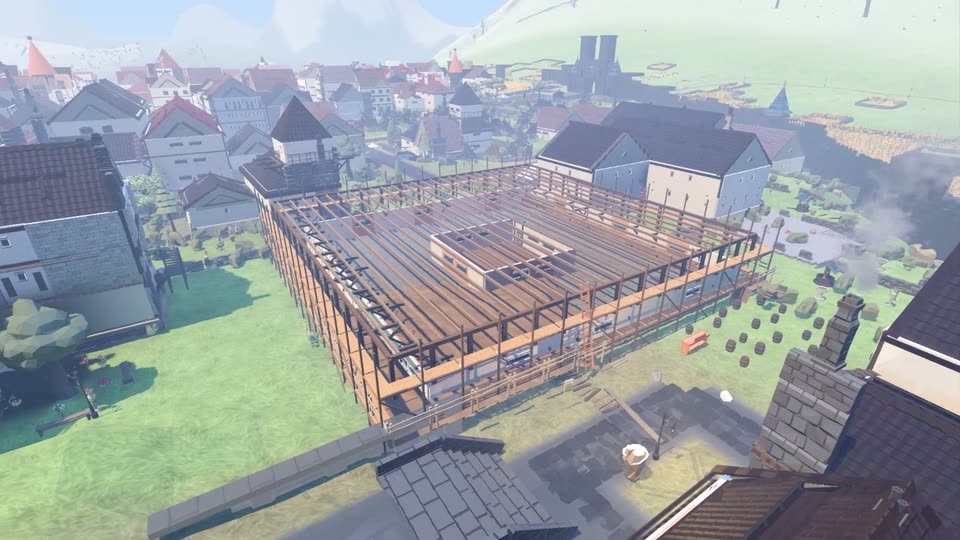
You will see those projects as real building sites in the street, moving through their stages from bare earthworks to a finished building. From the very first day, every city already has one project underway, so the world never looks freshly unwrapped.
The whole fund is saved with your game: the balance, the queue and every half-built site. Quit mid-project and the scaffolding is still there when you come back.
Spilling past the walls
A walled city can only hold so much. When a town grows into a bigger population tier, it grows outward, claiming the open ground around it for new streets and plots.
Old cities do the same. Many walled cities now start the game with faubourgs: the ragged districts that grow up just outside the gates, where the people who could not fit (or could not afford) the inside of the wall build their homes. Arrive at a big city and the first streets you ride through may be outside the wall, not inside it.
The world sets aside ground for monasteries before history even begins, so the quiet religious houses in the hills are not crowded out by the cities growing around them.
No hitches, ever
Turning a village into a town is a big job. The engine has to lay out streets, place plots and buildings, wire up the market and settle the population. Doing that in the middle of a fight would cost you frames you would feel, especially on a Steam Deck.
So we do not. A village that is ready to become a town waits for a time skip: a rest, a night at the inn, or any other skip forward in time. The promotion happens behind that moment, and you return to a world where the town is simply there. During normal play, the daily growth check costs under a millisecond.
You will never see a town build itself. You will just notice that it has.
Why it matters
Titan Saga is built on one idea: the world keeps living whether you are watching or not. Cities that grow are the most visible version of that. The village where you bought your first sword can become the town where you buy your best one.
Wishlist Titan Saga on Steam, join us on Discord and tell us which town you watched grow, and read about the powers that rule these cities in The Four Nations of Titan Saga.
See you on the road.
The Kneeshaw Developments team
Follow Titan Saga
Read more about the world on the Titan Saga page and in the wiki, or follow us on Steam for updates.
Follow on Steam