
Devlog · 2026-11-24
The Four Nations of Titan Saga
Borders that move, houses that break.
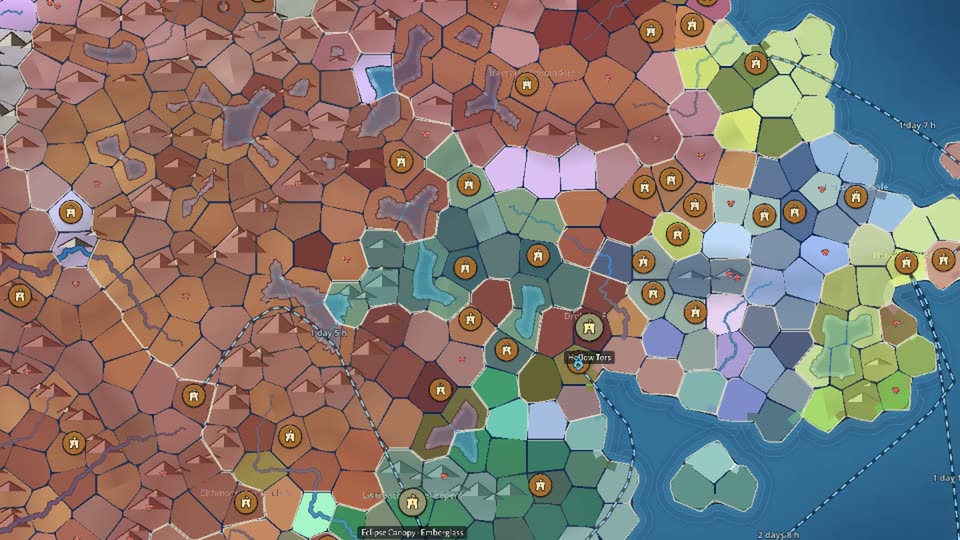
In most fantasy games, the political map is a painting. The kingdoms are where the artist put them, and they stay there no matter what happens in the story.
Titan Saga's map is drawn from the world itself. Every town belongs to a realm, every realm has a standing that changes day by day, and when a city falls the border moves with it. This post walks through the four great nations at the center of every world, and the rules that let them rise, fall and break apart while you play.
Four powers, every world
Each Titan Saga world is generated fresh, with its own geography, cities and history. Names are generated too, so your Empire will not be called the same thing as a friend's. But every world is built around the same four great powers, because the story needs them.
The Empire. The empire of man, and the nation that holds the city where your journey begins. Its heartland is temperate and its culture is classical: stone, law and old roads. Its people are mostly Fire Humans (about 80%), with Water Humans, gnomes and dwarves making up the rest.
The Elves. An elven realm, overwhelmingly elves (about 80%), with dark elves and dwarves living among them. Humans are almost unheard of there.
The Republic. A nation of Water Humans bound to the sea. It always holds at least one harbour city, and if history leaves it without a coastline, it founds a port town of its own. The Republic is the most mixed of the four: half Water Humans, a tenth Fire Humans, a third dwarves, gnomes, elves, dark elves and half-bloods, and a small minority of goblins, ogres, giants and rendrown who have made a life inside its walls.
The Shogunate. The eastern power. Its culture is always eastern, but its majority people are rolled fresh for each world. In one world it is a dwarven shogunate, in another a dark elf one, in another a goblin one. You will not know until you get there.
Four is a floor, not a ceiling. If a fifth nation grows strong enough during the world's history, it joins them as a major power.
Standing that rises and falls
Every nation has a standing: dominant, rising, stable, declining, and so on. It used to be set once when the world was made. Now it moves every day.
Each morning, every independent nation compares its strength today (its cities, its vassals' cities and its population) to where it started, and drifts toward where that strength says it should be. Lose cities and it slides. Fight too many wars at once and it slides faster. Win territory and it climbs.
Only one nation can be dominant at a time. The four great powers can be humbled, but never wiped out: their standing bottoms out at declining, so the story always has its Empire, its Elves, its Republic and its Shogunate, even if one of them is barely holding on.
Borders that are real
The world map now draws realm borders straight from who actually owns the land. There is no guessing and no painted-on territory. If a region belongs to the Republic, the map tints it Republic.
And when a city changes hands, the land goes with it. A conquered city takes its surrounding countryside and outlying villages into the new owner's realm, and the border on your map shifts to match.
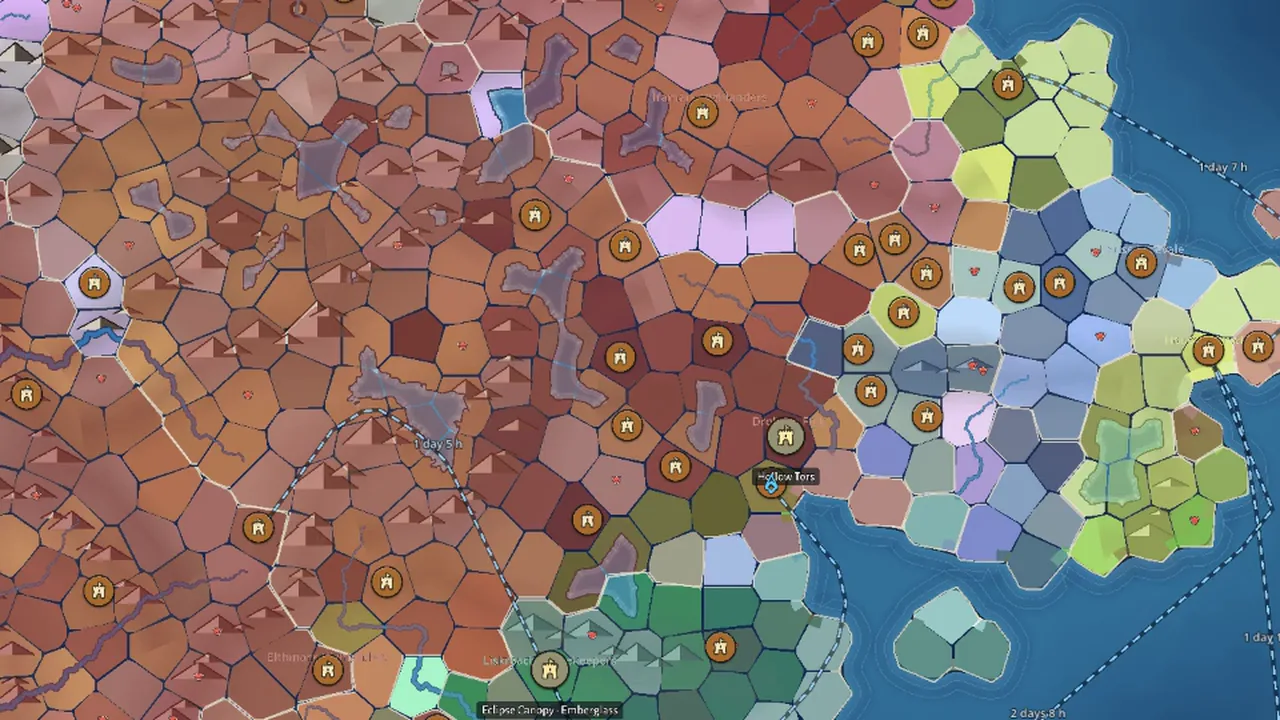
Before
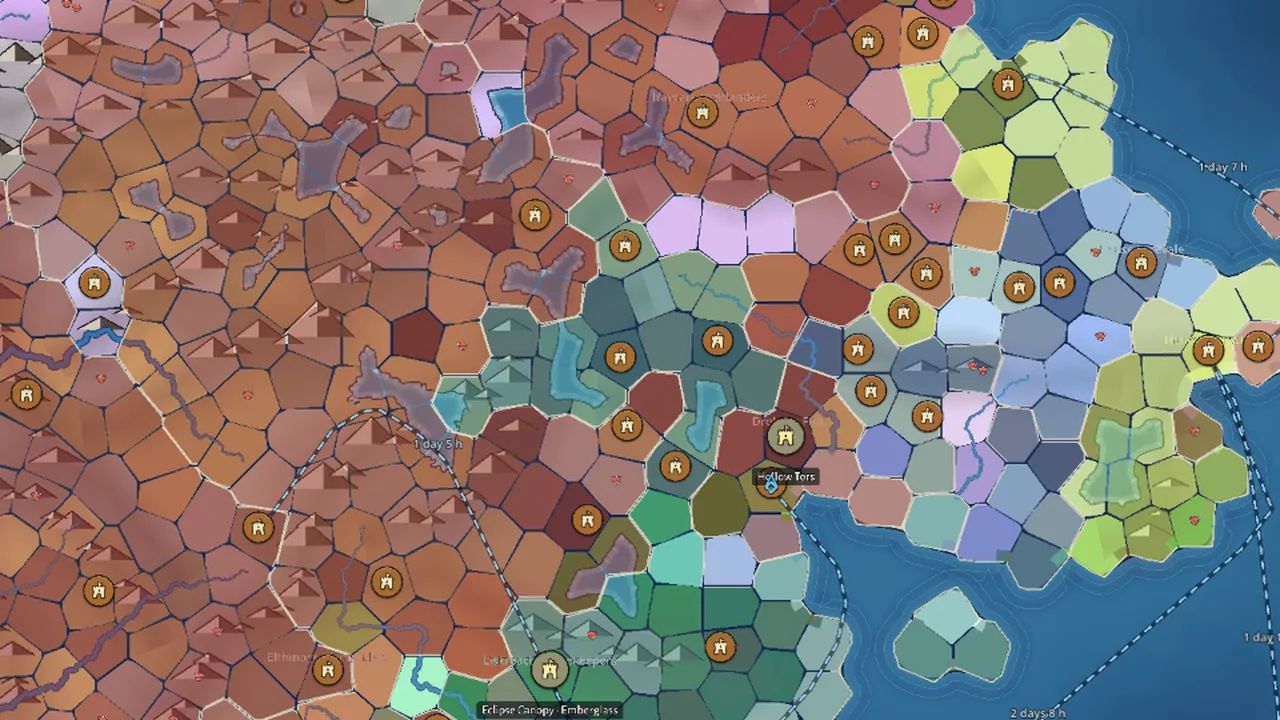
After
One thing does not change hands: the people. A conquered town keeps the people of the culture that built it. Take an elven city and it stays an elven city under new banners, which tends to make for interesting politics.
When the Empire breaks
The Empire is not one will. It is a crown and a set of great houses that serve it, some loyally and some because they have to.
When the Empire is declining and has been at war for ten straight days, the least loyal house breaks away. More can follow, one about every thirty days, up to three. What happens next depends on who they are:
- Great magnates declare their own realm and go to war with the crown. The Empire, in turn, marches to take back their seat.
- Lesser houses do not have the strength to stand alone, so they defect to the strongest rival power and bring their towns with them.
The houses that stay loyal remember who left. A world that starts with one Empire can end up with an Empire, a rebel realm and a few border towns flying a rival's flag.
Why build it this way
Titan Saga's story is set inside a living world, not on top of one. The great powers need to be there for the story to work, but the world should not freeze around them. These rules give us both: four nations you can count on, and a map you cannot take for granted.
The map you see on your first night is not the map you will see a season later.
Wishlist Titan Saga on Steam, join us on Discord to tell us which nation you would side with, and if you missed it, catch up on the big picture in The Dream Game Is Real.
See you on the road.
The Kneeshaw Developments team
Follow Titan Saga
Read more about the world on the Titan Saga page and in the wiki, or follow us on Steam for updates.
Follow on Steam